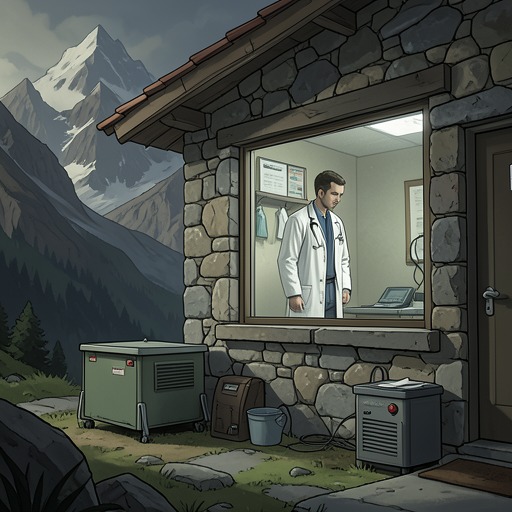
Review meeting at Gómez’s clinic
Hot MilkThe review meeting at Dr Gómez’s clinic turns Rose Papastergiadis’s treatment into a contest over who can define its progress: the patient, the clinicians, her daughter, or the officials recording answers on forms. Convened by a pharmaceutical-company executive and a health official from Barcelona, it brings a long, uncertain history of pain into a room organized around questionnaires, treatment plans, and institutional judgments. Rose’s testimony repeatedly exceeds those categories, while Sofia Papastergiadis’s blunt declaration about her mother’s condition briefly makes the family’s private fear audible in the formal proceedings.
Background and Stakes
The meeting follows an expensive and still unresolved course of treatment at the Gómez Clinic near Carboneras. Rose and Sofia have remortgaged Rose’s house to pay twenty-five thousand euros for care. For Sofia, investigating her mother’s symptoms has occupied much of her life: she remembers asking what a headache meant when she was four, and has since understood herself as a witness to Rose’s changing pains. Each apparent lead has been followed by another unexplained symptom and another medication, leaving the search for a cause open rather than resolved.
That uncertainty is not abstract in the clinic. During an earlier examination, Dr Gómez found small, slightly infected ulcers on the sole of Rose’s right foot and asked whether she had been tested for diabetes. Rose had also described a sharp tearing pain inside her left elbow after sneezing. Her symptoms arrive in clusters and across time; during one history-taking session, Sofia overhears more than twenty complaints and observes that Rose’s account moves between past, present, and future rather than following a neat chronology. Julieta Gómez Peña listens without rushing to fill silences, while Rose’s cough seems to precede disclosures she finds awkward or intimate. The later review therefore confronts a history that is extensive, but difficult to reduce to a single complaint or a clean measure of progress.
Medication is part of the conflict as well as its attempted solution. Dr Gómez had asked Rose to identify which medicines she felt attached to and which she could relinquish. He also told Sofia that administering her mother’s medication had become a ritual in both their lives, and suggested that caregiving had protected Sofia from making a life of her own. His intervention frames treatment as something that may shape the caregiver as well as the patient. Yet Rose subsequently tells Sofia that her pain continues to magnify and that her feet are numb, showing how little a change in medication alone settles the question of what is happening to her body.
The Review in the Consulting Room
The scene, headed Gómez on Trial, is staged beneath the electrocuted vervet specimen and glass case in Dr Gómez’s consulting room. A gaunt pharmaceutical executive, Mr James from Los Angeles, fidgets with a golf ball; his colleague, Señor Covarrubias from Barcelona, sits beside him. Dr Gómez stands before his desk, Julieta Gómez Peña perches on it, and Rose sits regally in her wheelchair, with Sofia beside her. The officials’ clipboards and the golf ball’s repeated movement make the encounter feel at once clinical and evaluative, as if an account of illness is being tested against a prepared instrument.
Mr James begins by asking about Rose’s two-night admission to the clinic. Rose explains that she was dehydrated. Dr Gómez says she received intravenous saline and emphasizes that Rose has difficulty swallowing water, which also makes it difficult for her to swallow medication. Rose adds that she is back on track and that a doctor at the hospital in Almería had also been concerned. These details complicate any simple judgment of the clinic: the meeting scrutinizes its care, but the problem under discussion includes a practical barrier to taking the treatment itself.
The officials’ and clinicians’ accounts then part company. Julieta says the treatment is in progress and that the clinic still has work to do, adding that the meeting should conclude so she and Dr Gómez can speak with Rose alone. Rose contradicts her directly: treatment is over, and she has made other medical arrangements for her return to London. The disagreement is consequential because it concerns not only whether the clinic has succeeded, but who has authority to describe the treatment’s status. Rose is not a passive subject of the review; she corrects its account of her care in front of the people conducting it.
Progress, Measurement, and Testimony
Señor Covarrubias asks whether Rose has received a progress plan explaining how her treatment is advancing and what it has achieved. Rose says she has seen no such plan. He then asks whether the treatment has helped her become more effective in her life. The question leaves her pale and trembling; she sits silent and gestures toward Sofia, a movement Sofia cannot confidently interpret as a request to leave, a greeting, or a plea for help. Julieta tells Rose she does not have to answer and that the choice is hers.
Rose eventually describes what she can do: she gets up, dresses, and does her hair. She contrasts this daily routine with her childhood, when she ran for miles, jumped hedges and ditches, and made whistles from grass. Her self-description as an old horse is more than a symptom report, but it does not fit easily into the officials’ boxes. They continue ticking their forms as she speaks. Mr James says the meeting was called because the officials are not convinced she is in safe hands. Dr Gómez responds with a list of investigations: tests for stroke, spinal-cord injury, nerve compression and entrapment, multiple sclerosis, muscular dystrophy, motor neurone disease, and spinal arthritis. He also points to a recent endoscopy whose results have not yet been discussed. The exchange sets documented investigation against the absence of a progress plan and the unresolved experience of pain; neither account simply cancels the other.
When Covarrubias invites Sofia to share her concerns, she says she does not know whether her mother is dead or alive. The remark gives stark form to the uncertainty that has accumulated through years of symptom-watching, though Rose is physically present in the room. Julieta looks anguished. Rose thumps the wheelchair and defends her daughter’s first-class degree, then addresses Sofia in Greek, a language Rose taught her from early childhood but which they rarely used at home. Her joke invokes a stereotype about Yorkshire and ends by denying that she owns a whippet. Sofia smiles and Rose laughs. For a moment their complicity interrupts the official story being assembled on the questionnaire: the two appear happier than they are, yet the shared joke is also a real exchange that the forms cannot register.
Aftermath and Significance
The scene does not produce a settled verdict on Rose’s diagnosis or on the success of the clinic’s treatment. Instead, it exposes competing standards of evidence. The officials seek a progress plan, functional improvement, and answers that can be checked off; Dr Gómez offers a catalogue of serious conditions already investigated; Rose supplies both practical details and an account of lost capacity that resists easy classification. Sofia brings the family’s long history of listening for, interpreting, and anticipating symptoms into the room, but her most forceful statement is also interrupted by Rose’s protective joke.
After the officials leave, Dr Gómez asks Sofia to leave so that he can speak privately with Rose. Before Sofia goes, Rose points out that the glass cage around the stuffed primate had shattered close to her daughter’s head and that Sofia has a small shard near her eyebrow; she asks him to cover the cage in future. The clinical review has thus also placed Sofia physically near harm, and Rose returns attention to her daughter even as the doctor seeks a private conversation with his patient. As Sofia exits, she thinks she sees the light go out of Rose and, at the same time, sees her beauty become vivid. The ending refuses the meeting’s narrowing frame: Rose remains a patient under scrutiny, but also a mother, a witness to her own history, and a person whose presence cannot be fully captured by the review’s forms.